The platform vs. the app it builds for you
Lovable-the-platform runs its own security programme, documents it, and handles account and billing security like any modern SaaS. That part is fine, and it is not what the security incidents have been about. Every publicly disclosed Lovable problem has been about the generated apps — code the AI wrote and deployed on your behalf, with a security posture nobody reviewed.
The reason is structural, not a Lovable-specific flaw: a code-generation tool optimises for the thing you asked for, which is a working app. Access rules, secret handling, and authorisation checks are not in your prompt, so they get whatever default the generator reaches for — and the defaults skew toward 'works immediately', which is rarely 'safe in production'. Any builder in this category shares the pattern; Lovable is just the one with the most public data.
What the incidents actually were
The record is specific. In April 2026, a mass data breach affected every Lovable project created before November 2025 — any user could read another tenant's source code, database credentials, and customer data by creating a free account. That followed CVE-2025-48757, where 170+ Lovable-built apps allowed unauthenticated access to user data because the generated API routes never added access control, and a separate February 2026 incident exposing tens of thousands of records. A 2026 audit of 62 Lovable apps found 63% carried critical or high-severity vulnerabilities, averaging around ten findings each.
The through-line in all of it is boringly consistent: missing row-level security on the database (so one user's query returns another user's rows), secrets exposed in the frontend, and endpoints that check whether you're logged in but not whether you should see the specific record you asked for. None of this makes Lovable unusable — it makes 'ship it as-is' the actual risk.
How to check whether your Lovable app is safe
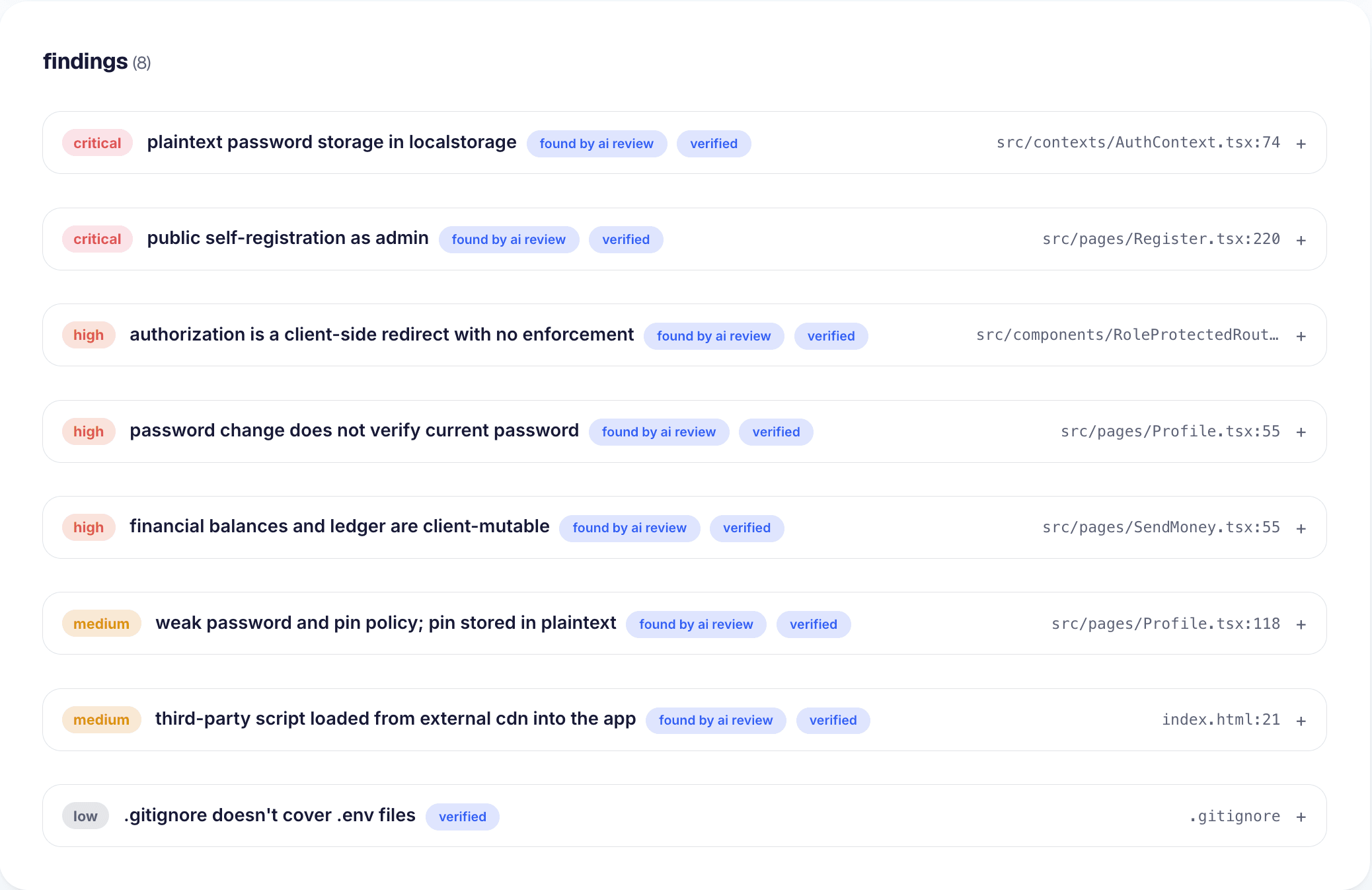
You verify the generated code, not the builder. The fastest read is a scan of the repo: paste your app's GitHub link into secure·vibes and you get a 0–100 score, every finding with its file and line, and a ready-to-paste fix prompt for the same AI tools you built with. It looks specifically for the Lovable failure modes — exposed keys, missing authorisation, the database-access gaps — and it reads the same public archive anyone could, so there's no access to grant.
If you'd rather spot-check by hand first: confirm row-level security is enabled on every Supabase table, search the frontend bundle for anything that looks like an API key, and try changing an ID in a URL to see whether you can load a record that isn't yours. Any one of those turning up a problem is the signal to scan properly and fix before launch — and to rotate any key that was ever exposed, because deletion doesn't un-leak it.
how it works
- 01
Separate the two questions
Lovable the platform is reasonably secure; the concern is the app it generated. Judge the code, not the builder.
- 02
Scan the repo
Paste your app's GitHub link into secure·vibes for a score, findings with file and line, and fix prompts — it targets the exact Lovable failure modes.
- 03
Check row-level security
Confirm RLS is on for every Supabase table; missing RLS is the single most common Lovable finding and leaks other users' rows.
- 04
Hunt for exposed keys
Search the frontend bundle for API keys. Anything client-side is public — move it server-side and rotate it.
- 05
Test authorisation, not just login
Change a record ID in a URL. If you can load data that isn't yours, the endpoint checks login but not ownership.
- 06
Fix, rotate, re-scan
Apply the fix prompts, rotate any leaked credential at the provider first, then re-scan to confirm the score moved before you launch.
What Lovable secures vs. what you own
| Layer | Who's responsible | Where the risk sits |
|---|---|---|
| Account, billing, platform | Lovable | Low — documented security programme |
| Database access rules (RLS) | You / the generated app | High — most common finding |
| Where API keys live | You / the generated app | High — keys land in frontend bundles |
| Endpoint authorisation | You / the generated app | High — login checked, ownership not |
frequently asked
So is Lovable actually safe to use?
The platform, yes. The app it generates for you needs a security pass before real users touch it — the public incidents were all about generated apps, not Lovable's own systems. Treat 'is Lovable safe' as 'is my Lovable app safe', and check it.
Was my app affected by the April 2026 breach?
That breach involved Lovable projects created before November 2025. Regardless of your project's date, treat any credential ever stored in a Lovable project as potentially exposed — rotate Supabase keys and third-party API keys, and enable row-level security on every table.
What's the single most important thing to check?
Row-level security on your database. Missing RLS is the most common Lovable finding and the one that leaks one user's data to another. If you check nothing else, check that every table has RLS enabled with real policies.
Do I need to be technical to check my app?
No. A secure·vibes scan needs only your app's public GitHub link and returns findings in plain language with a fix prompt you paste into your AI tool. The manual spot-checks (RLS on, no keys in the frontend, IDs not swappable) are also non-technical once you know to look.
Last updated July 16, 2026