What a code quality checker measures (and what it doesn't)
Quality here means maintainability, not correctness. A code quality checker looks at the shape of the code: how big the files and functions are, how deeply nested the logic gets, whether the same block is copy-pasted across files, whether dead and commented-out code is piling up, whether naming and conventions are consistent, and whether the repo has the basics — a README, a .gitignore, a lockfile. None of that changes whether the app runs today; all of it changes how hard tomorrow's change will be.
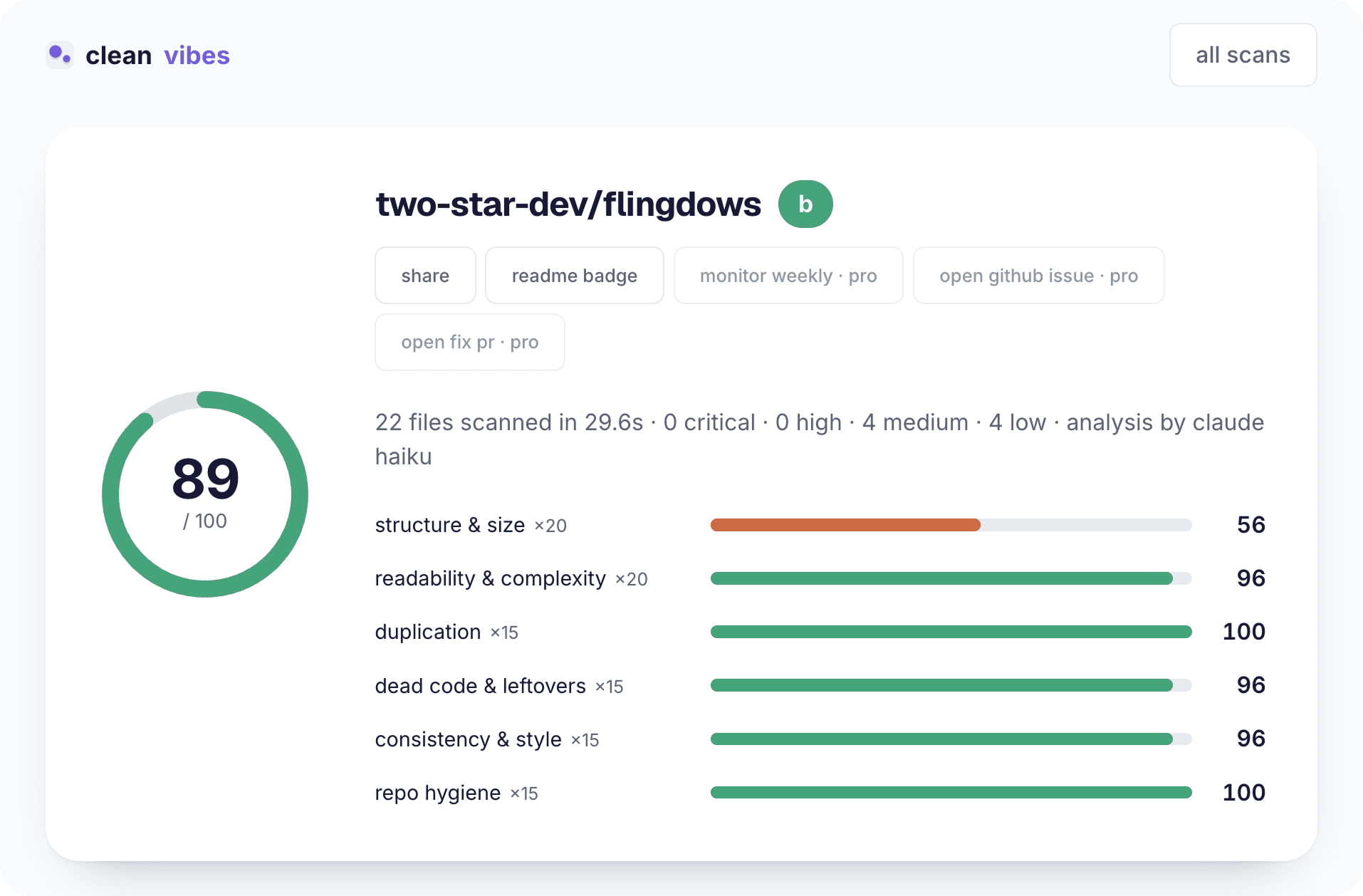
It is not a bug finder and not a test runner. A checker won't tell you the app is broken — it tells you the app is expensive to change, which is the problem that shows up three months in when a "quick" edit touches six duplicated copies. clean·vibes scores exactly these six categories, each starting at 100 and losing points per finding by severity, combined into one weighted 0–100 score.
Whole-repo checker vs. a linter
A linter (ESLint, Ruff, and friends) checks one file at a time against style and syntax rules — invaluable, and you should run one, but it can't see the repo. Cross-file duplication, a module nobody imports anymore, a codebase that's inconsistent between its old half and its new half — these only exist at the whole-repo level, and a per-file linter is blind to them by design.
A whole-repo code quality checker reads the codebase as one thing. That's the level where maintainability actually lives, and it's what clean·vibes scores: it streams the repo archive in memory, runs deterministic heuristics across the whole tree, then adds a Claude review pass that reads for the judgment calls rules miss — the two together producing a score, a ranked findings list, and a fix for each.
How to check a repo's quality in under a minute
Paste the GitHub link. clean·vibes fetches the same public archive anyone can download — no OAuth, nothing written to disk — and returns a 0–100 score with a letter grade (A ≥90 down to F), the six category subscores so you can see whether the problem is structure or duplication or hygiene, and every finding with its file, line, and a one-paste Claude prompt to fix it. Private repos work too, via sign in with GitHub.
The score is the summary; the subscores are the diagnosis. A repo scoring 78 with structure at 45 and everything else near 100 has one specific, fixable problem — oversized files — not a vague "needs cleanup." That's the difference between a checker that grades you and one that tells you what to do next.
how it works
- 01
Paste a GitHub link
Public repos need nothing but the URL; private repos work via sign in with GitHub. The archive is streamed in memory, never written to disk.
- 02
Read the overall score
0–100 with a letter grade (A ≥90, B ≥80, C ≥65, D ≥50, F below) — the one-number summary of maintainability.
- 03
Use the six subscores as a diagnosis
Structure, readability, duplication, dead code, consistency, hygiene — the low bar tells you what kind of mess it is, not just that there is one.
- 04
Work the findings list
Each issue comes with a file, line, why it matters, and a ready-to-paste Claude prompt with behaviour-preserving constraints.
- 05
Re-check to confirm
Fix, re-scan, watch the score move. The free tier covers about five scans a month.
frequently asked
Is a code quality checker the same as a linter?
No. A linter checks one file at a time for style and syntax; a code quality checker reads the whole repo for maintainability — cross-file duplication, dead modules, oversized files, inconsistency. Run both: the linter for per-file rules, the checker for the repo-level picture.
Does it check quality or find bugs?
Quality — how maintainable and clean the code is, not whether it's correct. It won't tell you the app is broken; it tells you the app is expensive to change, which is the problem tests don't catch.
Do I need to install anything?
No. clean·vibes runs from a GitHub link in the browser — paste the URL, get a scored report in under a minute. Nothing to install, nothing cloned to your machine, nothing written to disk on ours.
Can I check a repo I didn't write?
Yes, as long as it's public — which makes it useful for sizing up a codebase before you inherit it or a dependency before you adopt it. Paste the link and read the score and subscores.
Last updated July 16, 2026