What triggers a commission chargeback
The common triggers are all early-policy failures. A policy cancels within the chargeback window (often the first 6 to 12 months). A client stops paying and the policy lapses. A first premium NSFs, so the policy never really takes effect. Or a policy is rewritten or moved, which the carrier treats as a cancellation of the original. In each case the carrier's logic is the same: the commission was advanced against a policy that didn't stay on the books long enough to earn it, so it gets reversed.
Advanced commission makes this sharper. Many carriers pay a chunk of the year's commission up front, so if the policy dies in month three there's a large advance to claw back. That chargeback can dwarf the ongoing commission on the policies that are performing, which is how a good month on the statement turns into a flat or negative one.
Why chargebacks blindside agencies
Timing and presentation. The chargeback lands on a statement well after the sale, decoupled from the original payment, and the portal rarely explains it beyond a code and a negative number. You're left reverse-engineering which policy it belongs to and whether the reversal is even correct. When several chargebacks land in one period, the statement total drops for reasons that aren't legible on the page.
The deeper problem is the same one-sidedness as every other statement error: the carrier shows you the reversal, not your expectation of it. Without an independent record of which policies are inside their chargeback window and at what advance, a clawback is indistinguishable from an error. Carriers do make chargeback errors, reversing commission on policies that are still active or double-clawing a single cancellation.
Tracking chargebacks with a reconciliation
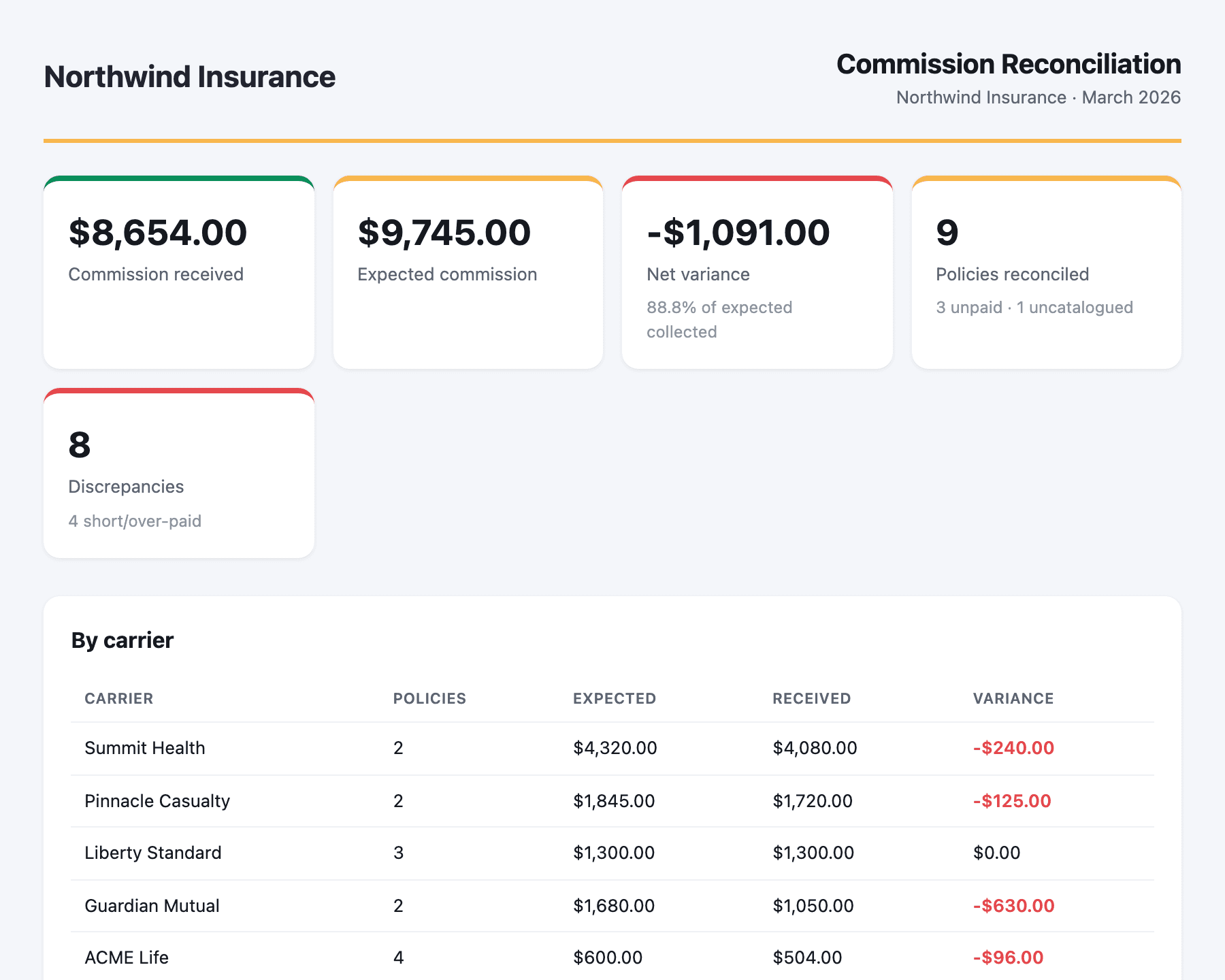
Reconciliation turns a chargeback from a mystery into a line item. When reportr reconciles the carrier portal against your book of business, a reversal shows up as a negative entry it can match back to a specific policy, so you can see what was clawed back, on which policy, and whether that policy actually cancelled. A chargeback you can trace is one you can verify, dispute if it's wrong, and account for if it's right.
It also makes the pattern visible over time. Because every statement is reconciled against the same book, chargebacks stop being isolated shocks and become a trackable line. You can see which carriers claw back most, whether reversals cluster around particular products, and whether a clawback matches a cancellation you already knew about. That's the difference between reacting to a shrunken cheque and managing chargeback exposure as a known part of the book.
frequently asked
What is a commission chargeback in insurance?
It's the carrier reclaiming commission it already paid you when a policy cancels, lapses, or NSFs inside the chargeback window, often the first 6 to 12 months. Because much commission is advanced up front, an early cancellation can trigger a large clawback on a later statement.
Why did my commission statement show a big negative line?
Almost always a chargeback, meaning a reversal for a policy that cancelled or lapsed. The portal rarely explains it well, which is why reconciling the statement against your book helps: it matches the negative line back to a specific policy so you can see what happened.
Can carriers make chargeback mistakes?
Yes. They reverse commission on policies that are still active, or double-claw one cancellation. An independent record is what protects you: without reconciling against your own book, an incorrect chargeback is indistinguishable from a correct one, and you can't dispute what you can't trace.
How do I track chargebacks across carriers?
Reconcile every statement against your book of business so each reversal is a traceable line, not a mystery deduction. reportr does this automatically and, because it reconciles the same book each time, makes chargeback patterns visible across carriers over time.
Last updated July 16, 2026