The six kinds of commission statement error
Short-pay: the policy is on the statement, but the amount is under your contracted rate. A payment arrived, just light, which is why it's the hardest to catch by eye. Unpaid renewal: an active or renewed policy that should have generated commission and produced no line at all, hiding in the gap between your roster and the statement. Miscredit: the commission was paid, but to the wrong agent, sub-producer, or hierarchy level, so it settled without reaching you.
Uncatalogued payment: money lands for a policy that isn't in your book, sometimes rightly owed and sometimes a sign your roster is stale. Duplicate: the same commission counted twice, which inflates a period and masks a shortfall elsewhere. Reversal or chargeback surprise: a clawback for a cancelled or NSF policy that you didn't expect and can't reconcile against anything, so it quietly reduces the cheque. Every one is a mismatch between two lists, not an obvious error on either list alone.
Why these errors survive on the statement
The structural reason is one-sidedness. Carrier portals are built to report what the carrier did, not to audit whether the carrier was right, and there's no column for "what you expected", so a short-pay and a correct payment look identical on the page. The volume compounds it. Across hundreds of policies and a dozen carriers, no human is going to eyeball every line against a mental model of the contracted rate, so the errors that don't announce themselves survive by default.
Being individually small is the other half of the cover. A single $40 short-pay isn't worth a phone call, so the call never gets made, and a hundred of them across a year is real money. They only become chase-able once they're aggregated into one list with a total attached. Malice isn't hiding these errors. The absence of a cheap way to see them is.
Catching all six with one reconciliation
The method that catches every error type is the same: hold your expected commission, taken from your book of business, next to the carrier's actual payment, line by line, and look at the mismatches. A short-pay is a line where expected exceeds paid. An unpaid renewal is an expected value beside a blank. An uncatalogued payment is a paid amount with no match in your roster. A reversal is a negative line you can trace back. Each error type is a distinct shape of mismatch, so a single comparison surfaces all six at once.
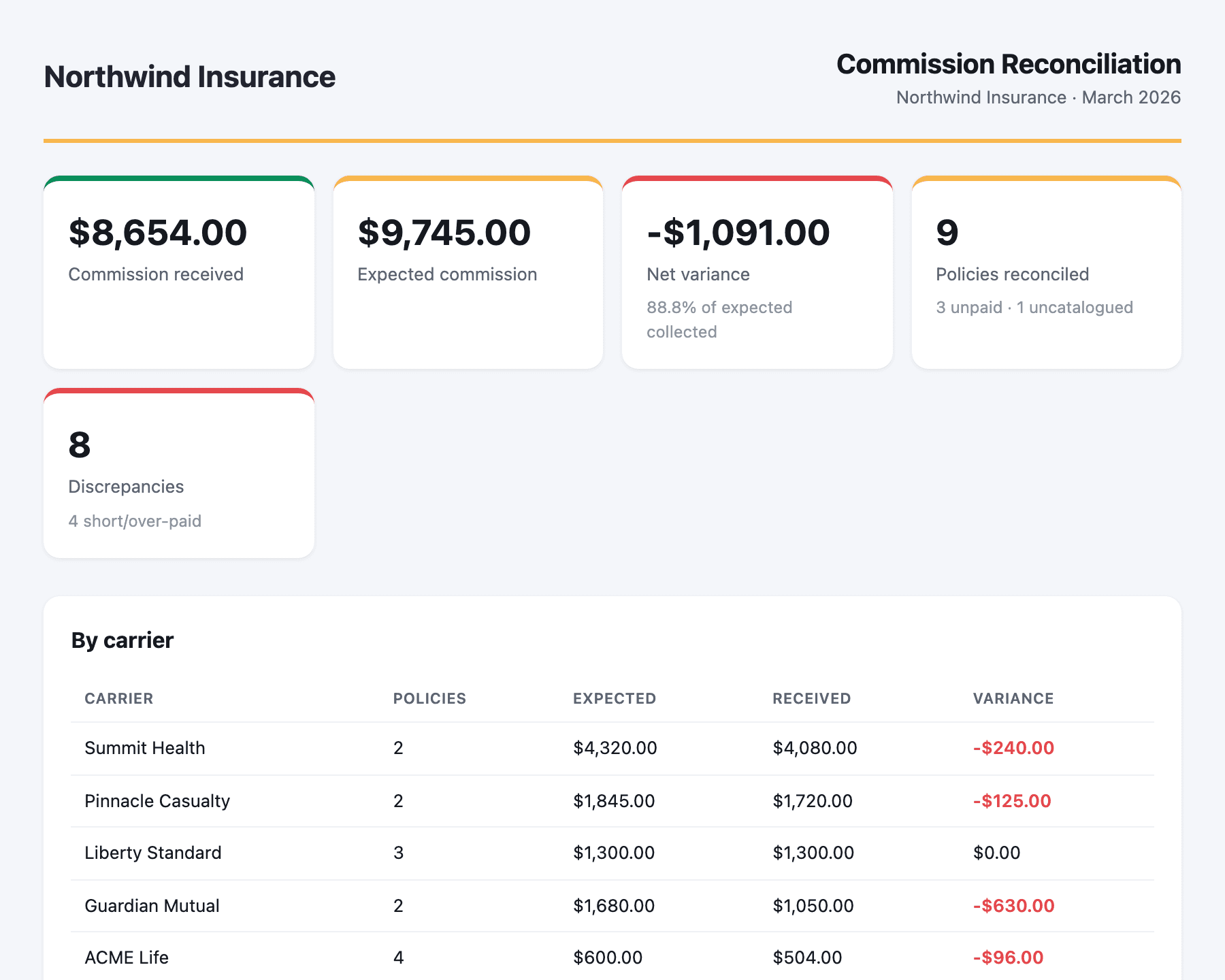
reportr runs that reconciliation automatically. It reads the carrier portal you're already logged into, loads your book of business, and reconciles expected against paid, flagging short-paid, unpaid, and uncatalogued entries with the amount and the reason, then exporting the list as a branded report. The work stops being a line-by-line hunt and becomes a review of a flagged exceptions list, which is the only version of this that scales past a handful of policies.
Medicare Advantage is the easiest place to start, because the expected side is published. We read 40,657 plan-year filings of what carriers tell CMS they'll pay agents, and 99.6% of plans file at exactly the CMS maximum, with renewal filed at half of it, rounded to the dollar, in every year since 2018. So for most of an MA book the expected value is a number you can look up rather than derive, and a short-pay becomes arithmetic rather than an argument.
The six commission statement errors and how each shows up in a reconciliation
| Error | What happened | How it appears |
|---|---|---|
| Short-pay | Paid under the contracted rate | Expected > paid on the same line |
| Unpaid renewal | Owed commission never paid | Expected value beside a blank |
| Miscredit | Paid to the wrong agent/level | Settled, but no line reaches you |
| Uncatalogued | Payment for a policy not in your book | Paid amount with no roster match |
| Duplicate | Same commission counted twice | Two identical lines for one policy |
| Reversal / chargeback | Clawback you didn't expect | Negative line, no matching expectation |
frequently asked
What's the most common commission statement error?
Short-pays, where a payment arrives just under the contracted rate. They're the hardest to notice, because the money came in and nothing looks wrong until you compare it against what the schedule implied. Reconciliation is what turns a short-pay into a nameable number.
How do I know if my carrier statements have errors?
You can't tell from the statement alone, since it only shows what was paid and not what was owed. The only reliable check is to reconcile each line against your book of business, and the mismatches are the errors. reportr does that comparison automatically from the carrier portal.
Are commission errors usually the carrier's fault?
Not always. Some are stale rosters on your side, some are real carrier mistakes, some are timing. A reconciliation doesn't assign blame. It produces an accurate exceptions list you can act on, whether that's a dispute, a roster fix, or a follow-up.
Can I catch these in a spreadsheet?
For a handful of policies, yes. Past that it breaks down. Pulling every carrier's statement, matching it to your roster, and flagging six kinds of mismatch by hand is the multi-day chore reportr replaces with a one-click reconciliation and a branded report.
Last updated July 16, 2026