What actually makes code 'spaghetti'
Spaghetti isn't one flaw — it's several structural ones compounding. The ingredients are consistent: giant files and functions that do too many things at once; the same logic duplicated in several places so no single piece is the source of truth; deep nesting that buries the real behaviour under levels of conditionals; and no separation of concerns, so data, UI, and business logic tangle together instead of living in their own layers. Any one of these is manageable; together they produce code where every change risks breaking something unrelated.
The defining symptom is fear. In tangled code, you can't predict the blast radius of an edit — so changes get slower, more cautious, and more bug-prone, and the codebase calcifies. That's the real cost of spaghetti: not that it's ugly, but that it makes the code expensive and risky to change, which is the thing that actually slows a project down.
Why AI tools produce spaghetti fast
A coding agent optimises for the prompt in front of it: make this feature work. It doesn't hold the whole architecture in mind the way a maintainer does, so it takes the locally-fastest path — add to the existing file rather than split it, generate a fresh copy of a block rather than find and reuse the existing one, nest another condition rather than restructure. Each decision is individually reasonable and collectively produces tangle.
Our scan of 549 self-described vibe-coded repos shows the fingerprints: deep nesting in 53.6%, files past ~600 lines in 56.1%, cross-file duplication in 46.4%, and more than half carrying at least one duplication finding. None of it stops the app working — which is exactly why it accumulates. The app runs, the preview looks done, and the tangle only announces itself later, when a change that should take an hour takes a day.
How to untangle it — measure first, then refactor
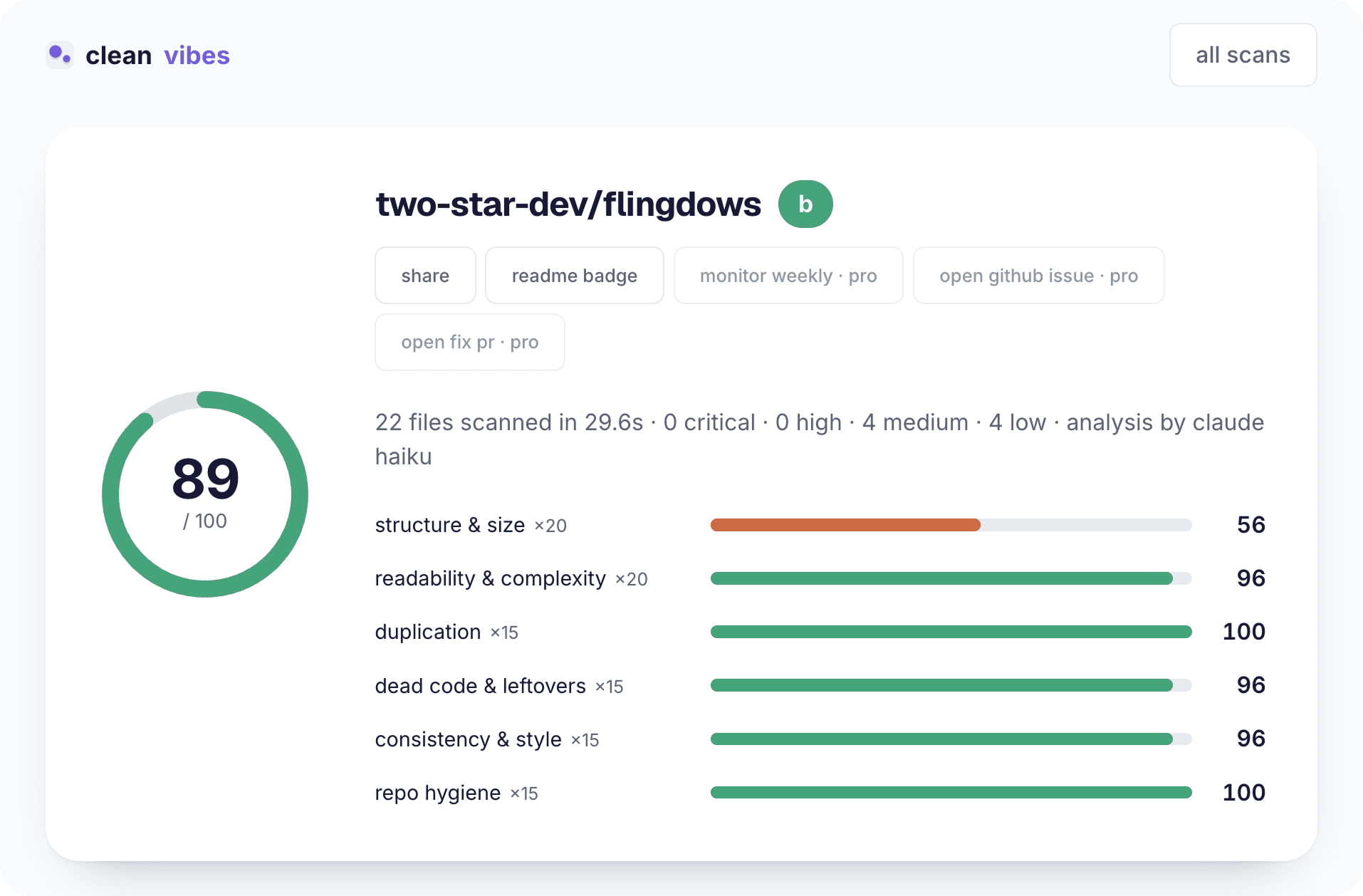
You can't untangle what you can't see, and "this whole repo is a mess" isn't actionable. The first move is to measure: which files are oversized, which blocks are duplicated where, which functions are nested past the point of readability. clean·vibes does this from a GitHub link — a structure-and-size subscore, a duplication subscore, and a ranked list of the specific files and functions dragging them down, so "spaghetti" becomes a short list of concrete targets.
Then refactor the worst offenders in small, behaviour-preserving steps: extract a duplicated block into one function, split a giant file along its real seams, flatten the deepest nesting, and re-check after each so you're never guessing whether you made it better. clean·vibes gives each finding a ready-to-paste Claude prompt with a "smallest change, keep behaviour identical" constraint, so an AI tool can apply the untangling the same way it wrote the tangle — one reviewable diff at a time. Fix, re-scan, watch the structure score climb.
how it works
- 01
Measure the tangle
Scan the repo with clean·vibes — the structure, duplication, and readability subscores show how spaghetti it really is, and which files are worst.
- 02
Target the worst offenders
Start with the biggest files and the most-duplicated blocks — the highest-nesting, highest-severity findings — not a vague full-repo rewrite.
- 03
Extract duplicated logic
Pull repeated blocks into one function so there's a single source of truth and one place to change.
- 04
Split giant files along their seams
Break oversized files into focused modules by concern — data, UI, logic — so each piece does one thing.
- 05
Flatten deep nesting
Use early returns and guard clauses to surface the real logic instead of burying it levels down.
- 06
Refactor in small steps, re-scan each time
Behaviour-preserving diffs only; re-scan after each so the structure score confirms you're untangling, not re-tangling.
frequently asked
What is spaghetti code, exactly?
Code with no clear structure, where control flow and dependencies are so tangled that following one feature means jumping all over the codebase. It's caused by duplication, oversized files, deep nesting, and no separation of concerns compounding together.
Why does AI-generated code become spaghetti so quickly?
Coding agents optimise for the immediate prompt, not the whole architecture, so they take the locally-fastest path — add to the file, copy the block, nest another condition. Each choice is reasonable; together they tangle. In our 549-repo scan, ~46% had deep nesting and oversized files.
How do I fix spaghetti code without rewriting everything?
Measure first, then refactor the worst offenders in small, behaviour-preserving steps — extract duplication, split giant files, flatten nesting — re-checking after each. A full rewrite is riskier and usually unnecessary; the tangle is concentrated in a handful of files.
How do I know if my repo is spaghetti?
Paste your GitHub link into clean·vibes: a low structure-and-size or duplication subscore, with findings clustered in a few big files, is the signature. It turns "this feels messy" into a specific list of what to untangle and where.
Last updated July 16, 2026